 |
|||
|
|||
|
|||
 |
|||
|
|||
|
|||
|
|||
|
|||
|
|||
|
|||

IR Share is a privately- owned, independent, apolitical company whose aim is to inform and assist all players involved in social dialogue within and outside Europe. It has been the correspondent organisation for France of the European Foundation for the Improvement of Living and Working Conditions since 2009. |
|
Lead story Mobilising to meet a target of zero deaths at work 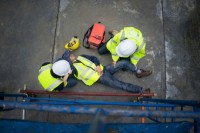 On International Workers Memorial Day (28 April), when those killed or injured at work are remembered, the European Trade Union Confederation (ETUC) published the Zero death at work manifesto, signed by trade unionists, researchers, MEPs and ten or so European ministers. The signatories point out that in the EU, every working day, 12 working people do not come home from work because they have died at work. They urge “the European Union, member state governments and employers to bring an end to deaths at work. We call for zero death at work.” The signatories believe that this target “is not a utopian dream. The trend in fatal workplace accidents is down and eradication of fatal accidents is achievable.” The number of fatal workplace accidents in the EU fell by approximately 70% between 1994 and 2018. The European Commission points out that “Despite this progress, there were still more than 3,300 fatal accidents and 3.1 million non-fatal accidents in the EU-27 in 2018, and more than 200,000 workers die each year from work-related illnesses”, (see Occupational accidents and diseases). Moreover, since the early 2010s, the decline in the number of fatal accidents has slowed down significantly. The latest figures published in Italy show an 11.4% rise in fatal workplace accidents in 2021. In Spain, the UGT’s occupational health secretary, Ana García de la Torre, points out that there were 705 deaths at work in 2021 (see press release). In a joint manifesto (see UGT and CCOO websites, and CCOO press release), launched as discussions commence on drawing up the 2022-2027 occupational health and safety plan, the two confederations explain that as business picks up again within the framework of the recovery plan, and major investments are being made in sectors experiencing high accident rates, strengthening “active public policies aimed at preventing work-related risks is one decisive step, and boosting inspection activity is another”. |
|
1. European Union Proposal 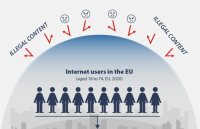 Digital Services Act (DSA) : On 23 April, the European Parliament and Council concluded a political agreement on the Digital Services Act (DSA), which will set the standards for a safer and more open digital space for users and a level playing field for companies for years to come (see press releases issued by the Parliament and the Council). This legislation “translates into practice the principle that what is illegal offline must also be illegal online”, emphasised the President of the European Commission, Ursula von der Leyen. The Parliament’s rapporteure, Christel Schaldemose (S&D), said: “citizens will have better control over how their data are used by online platforms and big tech-companies”. Eurocadres welcomes the conclusion of the negotiations, “in particular the inclusion of algorithmic transparency and the protection of personal data”. According to Eurocadres, this law, which will protect consumers, should be supplemented by the adoption of the directive providing protection for platform workers, because “only enforceable European action can protect both consumers and workers” (see press release). |
 Preventing “strategic lawsuits against public participation” : Following the adoption of Directive 2019/1937 of 23 October 2019 on whistleblower protection (see Whistleblower protection), on 27 April, the European Commission unveiled measures to enhance the protection of journalists and human rights defenders against abusive legal proceedings, commonly known as “strategic lawsuits against public participation” (“SLAPP”). These lawsuits are brought primarily against journalists and human rights defenders, including those defending workers, either to prevent them speaking about matters of public interest or to penalise them. To protect people against this form of harassment, which affects trade union officials, the Commission has put forward: 1/ a proposal for a directive covering strategic lawsuits against public participation in civil matters with cross-border implications. 2/ A recommendation to encourage Member States to align their rules with the proposed EU law (see press release). The European Trade Union Confederation, which reports several cases concerning trade union officials, wants such officials to be expressly referred to in the future law (which is not the case under the current proposal) and is calling for this to apply to national situations, too. In other words, a recommendation alone is deemed not to be a strong enough measure, and the Commission should adopt legislation to make such protection binding in each Member State (see press release). |
|
Social update 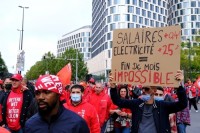 Tense wage negotiations : Following the efforts made during the Covid-19 pandemic and now that inflation has returned to Europe, a number of wage negotiations are proving particularly tense. In the United Kingdom, members of Unite the Union recorded an 86 per cent yes vote in favour of strike action, in response to “GSK making a derisory pay offer of just 2.75 per cent, a substantial real terms pay cut for the workforce, with the true rate of inflation (RPI) currently standing at nine per cent” (see Unite press release). Similar tensions are apparent at the Stanlow oil refinery, which belongs to the Veolia group, where Unite is denouncing management’s proposal to increase pay by 3.5%, resulting in “a substantial pay cut” (see press release), and at Whirlpool, which is offering a 2.5% increase (see press release). However, Unite is satisfied with some businesses, such as Airbus, which is offering a 8.6% pay rise over 13 months, plus a backdated lump-sum payment of 5.1%. Employees will also have an additional day's holiday in 2023 and 2024 (see press release). In Germany, as wage negotiations got under way in the steel industry, IG Metall’s collective-bargaining committee set the tone by calling for a 8.2% pay rise over 12 months (see press release). “Quite rightly, workers were expecting their pay to improve again after two years of wage restraint”, says the IndustriAll Europe trade union federation, “but they are now seeing their purchasing power eroded by galloping inflation, high energy prices and high prices for consumer goods. Employers don’t appear to be prepared to meet workers’ wage claims.” IndustriAll’s Deputy General Secretary, Isabelle Barthes, is calling on “governments to support households and employers to compensate workers. Social dialogue and collective bargaining must be strengthened, so that wealth can be redistributed more fairly in society.” In light of high levels of dissatisfaction on the ground at nation level, European Works Councils are also starting to address the subject of a just redistribution of added value. |
|
2. Member States Spain  Regulation of internships : As stipulated by Royal decree-law 32/2021 of 28 December 2021 enacting urgent labour reform measures, on 22 April, the government convened a round table session devoted to drafting the exact wording of “intern status”, in conjunction with the trade-union confederations CCOO and UGT and the employers’ organisations CEOE and CEPYME. This initiative, which echoes the concerns of MEPs who want better regulation of internships, seeks to protect the rights of interns employed by companies and institutions, to reduce levels of precarious employment and to tackle possible abuses in the form of recruiting “bogus interns”. According to the Ministry of Employment, between 2020 and March 2022, the Labour Inspectorate identified 3,164 jobs held by bogus interns (see press release). |
|
France
|
|
Ireland
|
|
Italy
|
|
3. Third countries United Kingdom - Scotland
|
|
United Kingdom 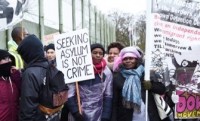 UK-Rwanda agreement on asylum seekers : The British government and Rwanda have signed a cooperation agreement to send migrants and asylum seekers of various nationalities arriving in the UK to Rwanda, especially those who set off from the French coast and cross the Channel (see government press release). At the same time, Parliament is scrutinising a government bill that will allow offshore centres to be set up, where migrants can be relocated until their application is processed and from where they can be turned back before they enter British territorial waters. The UN High Commission for Refugees (HCR) warns that this law is likely to be in breach of the Geneva Convention for Refugees. The agreement has prompted a strong reaction from Unite the Union, which condemned “outright” this “hideous, inhumane proposal to send those seeking asylum in the UK to detention in Rwanda”. The union believes that the new mechanism is designed to force asylum seekers to settle in Rwanda, and denounces the fact that in doing so, the government “will task men and women working in the UK, inevitably including Unite members, with the odious responsibility of processing and transporting these vulnerable human beings at an enormous cost to the public purse”. Unite’s view is that “this policy diminishes our international standing as a country which champions respect for humanity” (see press release). |
|
4. Companies European works councils  Safeguarding social commitments : On 21 April, the Engie EWC adopted an opinion on the Engie group’s sale of its Equans subsidiary to the Bouygues group. This text is particularly enlightening in terms of showing how closely the Engie EWC is involved in the process of selling off this subsidiary (see IR Notes 184). The EWC and Bouygues management had earlier signed a memorandum of understanding, on 13 April, safeguarding the social commitments given by Bouygues management to the EWC at the time of the sale and setting up a temporary social dialogue body dealing with Equans’ European activities and similar activities at Bouygues. This body, which is independent of the Bouygues EWC, will remain in place for a maximum of 18 months after the deal has been closed, during which time Equans management will negotiate a methodology agreement to adapt this temporary body into a permanent one.
|
|
European company  Applying the “before-after” principle to a transformation into a European company : The Advocate General of the EU Court of Justice has delivered his opinion in a case concerning compliance with German law on joint management, where a company is being converted into a European company (SE). When the SAP group was converted into a SE, the agreement on employee involvement maintained parity on the group’s supervisory board, but removed a specific mechanism allowing two trade union officials who are not group employees to sit on the board (see IR Notes 180). The Court of Justice has been asked to rule whether the specific ballot for the election of trade union representatives to the supervisory board of a SE that arose from the transformation of a German public limited company must be maintained, under Article 4, paragraph 4, of the SE Directive (the “before-after” principle), or whether it may be dispensed with by negotiating the agreement on employee involvement referred to in Article 4, paragraph 1, of the directive. In his opinion, the Advocate General clearly finds in favour of the IG Metall and Ver.di trade unions which brought this case to court: Article 4, paragraph 4, must be interpreted as meaning that “the agreement on employee involvement in an SE created by way of transformation must provide for a separate ballot for the election, to employee representatives’ posts within the Supervisory Board, of a certain proportion of candidates put forward by the trade unions, where that specific requirement is provided for and mandated by the national law applicable to the company to be transformed.” (see CJEU, Opinion, 28 April 2022, Case C-677-20, IG Metall and Ver.di, and press release). |
|
5. Studies and reports  Social dialogue as a weapon against Covid-19 : On 28 April, which was World Day for Safety and Health at Work, the ILO published a report entitled “Enhancing social dialogue towards a culture of safety and health: What have we learned from the COVID-19 crisis?”, showing how social dialogue contributed to the rapid and effective implementation of measures during the Covid-19 crisis. The ILO’s Director-General, Guy Ryder, said: “The lessons learned from this crisis about the importance of social dialogue in strengthening safety and health at the national and workplace level, need to be applied to other contexts. This would help reduce the unacceptable level of occupational deaths and disease that occur every year.” |