 |
|||
|
|||
|
|||
 |
|||
|
|||
|
|||
|
|||
|
|||
|
|||
|
|||

IR Share is a privately- owned, independent, apolitical company whose aim is to inform and assist all players involved in social dialogue within and outside Europe. It has been the correspondent organisation for France of the European Foundation for the Improvement of Living and Working Conditions since 2009. |

|
Lead story MEPs want to strengthen the legal framework governing company restructurings  On 20 January, by a large majority, MEPs adopted a resolution in favour of a directive for a just transition in the world of work. The text in question adopts the one adopted by the Committee on Employment and Social Affairs, with the exception of deleting, from the body of the text, the explicit request to the European Commission to put forward a proposal for a directive. This concession to EPP conservatives is a symbolic one, as the text was adopted within the framework of a so-called “legislative initiative” report. In other words, the Commission will in any case have to indicate whether it plans to propose a law, or if not, justify its refusal to do so. Moreover, the mention of a directive is retained in the resolution’s title and its annex, which sets out recommendations. Parliament had already called in 2023 for a directive to strengthen workers’ rights, with a view to anticipating changes, and thus restructuring processes (see IR Notes 219 and Parliament’s briefing). This time, MEPs are arguing in favour of the proposal, stating that the success of the twin ecological and digital transition “will depend heavily on ensuring that transition is just and inclusive for workers, businesses and regions and that it contributes to social justice for all”, so that “no one is left behind”. |
|
1. European Union Social update  Restructuring : On 19 January, the European Commission proposed mobilising 1.6 million euros from the European Globalisation Adjustment Fund (EGF) to help 267 workers dismissed after the bankruptcy and closure of Tupperware Belgium in February 2025 (see press release). |
 European Pillar of Social Rights : Having been pressed by MEPs, who submitted an oral question to the European Commission in December last year, Roxana Mînzatu, Executive Vice-President of the Commission for Social Rights, responded during a debate in the European Parliament on 22 January. She announced that the Commission would present “the results of the review of the 2021 Action Plan in July”, adding that “future actions will be defined on the basis of a thorough analysis of implementation” of the first Action Plan adopted in 2021, “but also, importantly, in view of the gaps and the new needs that have been identified”. |
|
Sectoral social dialogue  Banking : On 15 January, European social partners in the banking sector signed a joint statement on preventing violence and harassment in the workplace. The text covers the issues of gender-based and domestic violence, and workplace-related third-party violence and harassment. It invites social partners to roll out measures covering prevention, detection and victim support, at all levels — including at multinational companies. As well as actions involving awareness-raising for employees and training for managers and supervisors, the signatories call for measures such as extending internal rules on prevention to encompass remote work situations, offering the employees concerned, at their request, flexible work arrangements and/or leave, and refraining, wherever possible, from any disciplinary or dismissal measures for being late to or absent from work, in cases with evidence of workplace-related violence or harassment (see press release). |
|
2. Member States Austria  Employment for the over-55s : Long-term unemployed persons aged over 55 will enjoy better access to the labour market, thanks to a measure that will create between 3,000 and 6,000 jobs (see press release), via subsidies to the not-for-profit or ‘social and solidarity economy’ (SSE) sector (60%), and aid granted to private companies, to encourage them to employ these workers (see press release). The measure is broadly supported by the trade unions. However the ÖBG trade union confederation is seeking an assurance that these employees will have appropriate working conditions, and the Chamber of Labour (AK) emphasises that this funding should be maintained over the long term (see ÖBG and AK press releases). |
|
Bulgaria  Parenthood : Parliament has enacted changes to the Labour Code and the Family Code, incorporating measures to enhance the working conditions of employees who have children. The emphasis has been placed on greater flexibility for remote working and tailored working hours, to encourage a better work-life balance (see press release). |
|
Finland  Labour market reforms : On 15 January, the government submitted a bill to Parliament covering labour market reforms, with the aim of implementing these measures on 1 April this year. The government says that the new flexibility being introduced to employment legislation is intended to “facilitate the recruitment of new workers, especially for SME”. These reforms include: 1/ allowing employers to recruit employees on one-year fixed-term contracts without having to provide justification for this, where the contract of employment in question is the first one signed between them; 2/ granting the employer the right to terminate such a fixed-term contract after six months, though the employer must justify its decision; 3/ reducing the notice period for dismissal from 14 to 7 days; 4/ removing the obligation for companies with fewer than 50 employees to rehire a worker who has previously been dismissed for non-personal reasons, when further recruitment takes place. |
|
Greece  Reforms to the system of collective labour agreements : Social dialogue passed an important milestone in December when the Ministry of Labour and Social Security put forward a bill entitled the “Social Accord for Enhancing Collective Labour Agreements”, concluded between the government and social partners. This initiative, which has been welcomed by — among others — the Executive Vice-President of the European Commission, Roxana Mînzatu, is intended to strengthen the legal framework of social dialogue and to promote collective bargaining (see Ministry of Labour press release). This bill is based on a National action plan adopted by the Ministry of Labour, in accordance with Directive 2022/2041 on adequate minimum wages. The action plan, which will run until 2030, has five main themes: 1/ strengthening the legal framework governing collective bargaining; 2/ establishing a dedicated working group that will bring social partners together; 3/ gathering and enhancing the statistical data available on collective bargaining coverage; 4/ research, information and training actions; 5/ monitoring implementation of these measures. |
|
Netherlands  Noise pollution : A report submitted on 10 November to the Ministry of Social Affairs and Employment, reveals that more than 50% of workers suffer noise disturbance; 34% of them experience fatigue, stress and problems with concentration as a result of this (see SER press release). According to the authors, who investigated working conditions in “open spaces” – an area that is frequently overlooked in research – the main sources of disturbance are conversations between colleagues (56%) and noise made by equipment and machinery, such as printers, acoustic warning systems and alarms (over 30%). |
|
Norway  Psychosocial risks : As a result of the amendment to Article 4-3 of the Working Environment Act adopted by Parliament on 20 June, the requirement for a fully adequate working environment has explicitly applied to psychosocial aspects since 1 January. The text provides four new examples of psychosocial risks that employers must take into account: 1/ unclear or contradictory demands or expectations; 2/ emotional demands and psychological tension (especially in work involving human interaction); 3/ excessive workload and time pressure; 4/ a lack of support in the workplace (see Labour Inspectorate press release). |
|
Sweden  Pay transparency : On 15 January, at the Council of State (Lagrådet), the government put forward a bill transposing the directive on pay transparency, which it plans to present to Parliament (Riksdag) in the spring, so that it can enter into force on 1 July. Among other things, this bill requires employers with at least 100 employees to compile a report on pay, containing information on average gender pay gaps. This document must be passed on to the Equality Ombudsman (DO), who will be required to publish certain sections of the report (see press release). |
|
Czechia  Change of job : In a ruling on 26 November, the Constitutional Court rejected an application to repeal a section of the Labour Code that allows an employer, in certain situations, to transfer an employee to a different position without their agreement. In particular, the disputed provision concerns cases where an employee is no longer able to carry out the job specified in their contract of employment, for example for health reasons. The Constitutional Court judges deem such a transfer to be a temporary solution, until such time as the employer and employee can agree a way forward. However, the Czech and Moravian Trade Union Confederation (ČMKOS) wants the legislation to be adapted, so that the change of job is an outcome agreed between the employer and employee. |
|
3. Companies Transnational agreement 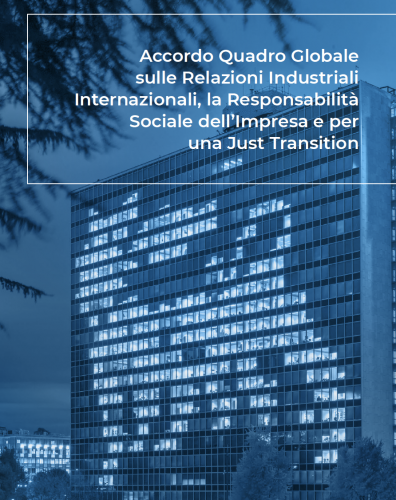 Agreement renewed : On 13 January, the Italian energy company Eni and the IndustriAll Global Union federation renewed their Global Framework Agreement on International Industrial Relations, Corporate Social Responsibility and a Just Transition. This revision introduces several major changes to the first text, signed in 2019, for example the inclusion of ILO Convention no. 190 on Eliminating Violence and Harassment in the World of Work, and strengthening due diligence in the field of human rights across the entire supply chain. The agreement also reaffirms the role of social dialogue in accompanying the energy transition and organisational restructuring, while emphasising the need for a just transition for workers (see press release). |
 Basic rights : On 15 January, the state-owned Norwegian company Vinmonopolet, which holds a monopoly on retail sales of alcohol, and the IUF international trade union federation, signed a memorandum of understanding establishing a complaints mechanism for reporting cases of labour rights violations by employers producing alcoholic beverages or agricultural raw materials used in products marketed by Vinmonopolet. Similar agreements have been concluded by the Swedish (Systembolaget) and Finnish (Alko) monopolies (see press release). |
|
Corporate social responsibility  Global trade union network : On 14 and 15 January, the IndustriAll Global Union federation organised a meeting in Indonesia, attended for the first time by around thirty trade union representatives from Adidas supplier countries, and a delegation from the German chemical industry trade union (IGBCE). The aim of this initiative was to boost coordination between trade unions in Adidas production countries (see press release). The discussions covered labour and environmental standards in supply chains, breaches of human rights in Burma at the supplier Pou Chen Group, and the decision taken by Adidas, in Germany, to withdraw from the footwear industry’s sectoral collective agreement (see press release). IndustriAll Global Union is calling on Adidas to commence negotiations with a view to concluding an international framework agreement. |
|
4. Studies and reports  Social protection : The European database MISSOC, which provides information on social protection systems in all EU countries, plus Iceland, Liechtenstein, Norway and Switzerland, has been updated. The database, which also allows comparisons to be made between countries, can be consulted in English, French and German. Access is free and open to all. |